
Problem List Reconciliation
In a two-week sprint with the Department of Defense, I co-designed approaches to problem list reconciliation with working physicians—exploring faster ways to relate, consolidate, and review diagnoses inside a complex military EHR.
- EHR Usability
- Clinical Research
- Problem Lists
Problem list reconciliation in military EHRs
In 2015, I worked with the DoD on EHR usability research focused on one of the most persistent pain points in electronic records: the problem list. Through interviews, co-design sessions, and rapid prototyping with clinical SMEs, we explored interaction patterns that could make reconciliation faster, clearer, and more trustworthy without adding administrative burden.
Challenge
The Problem List is a Shared Pain Point
In health informatics circles, problem lists are often described as the problem of all EMRs—because few systems present them well. As diagnoses accumulate over time, inconsistent documentation, duplicate entries, and unclear standards make lists harder to scan, trust, and reconcile—leaving critical context buried in long, difficult-to-read records.

From the clinic
“The document can quickly grow to 30 or more lines of text, making a clear and quick understanding of the patient's health nearly impossible.”
“Different codes are added to the problem list that reference the same disease. The problem list becomes redundant…”
“One physician would not add 'persistent cough'… Yet, if that patient is admitted to the emergency room, such information could be a key clue for determining treatment.”
The impact
Overgrown lists, redundant entries, and unclear governance make problem lists hard to trust and slow to reconcile—pulling clinicians away from the clinical picture and toward administrative cleanup.
Prototyping
Fast, Direct Reconciliation
“Something that lets you somehow update the problem list in a user-friendly way that takes like five seconds.”
— Emergency physician
Direct manipulation
Early concepts supported the right relationships, but they asked for too much navigation—new windows, extra taps, and heavy attention shifts.
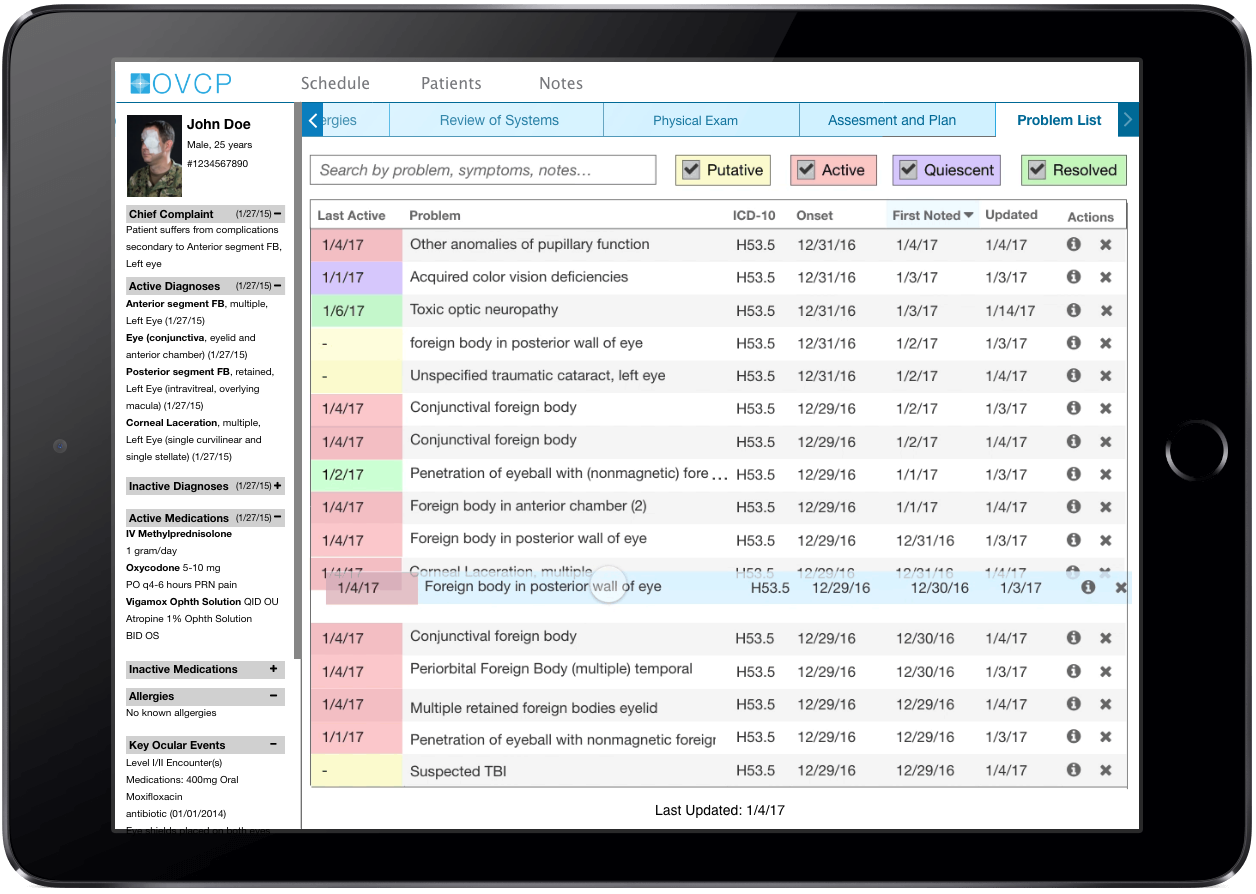
Letting clinicians drag one problem onto another to define a relationship became the core of the interaction: fewer steps, less context switching, more time on the clinical decision.
Hick's Law
Too many relationship types slowed people down. I collapsed the set to two high-value options: Similar to for duplicates and close cousins, and Secondary to when one problem was a consequence or symptom of another.
Click-through prototype: Shown to clinical SMEs for qualitative feedback on speed and clarity.
Refinement
Status, Timing, and History
“We sometimes see quiescent inflammation that becomes active, then back to quiescent and back to active.”
— Ophthalmologist
When was it last active?
Recurrence timing often signals when management should change. I explored sort orders that surface last active alongside status tags (putative, active, quiescent, resolved) so the list reads as a timeline, not just a stack of labels.
What's the history of the problem?
An info view could expose the full arc for a diagnosis—labs, referrals, notes—scrubbed through a compact activity strip so clinicians could see quiet and busy periods at a glance.
Linking common workups to a diagnosis could also reduce missed follow-up when the chart is dense.
Later iteration: Resolved filters, info affordances, and calmer hierarchy for review.
Formative feedback
What Clinicians Said
Qualitative sessions validated the direction; together with structured feedback, the program advanced toward summative testing.
This is an efficient and effective method for problem list reconciliation.
- 60% strongly agreed
- 40% agreed
- 0% were neutral or disagreed
“I like the tools used to better represent the clinical picture.”
This novel method of reconciling the problem list will support more effective care coordination.
- 80% strongly agreed
- 20% were neutral
- 0% disagreed
“This is a great way to provide a sub-structure to the overall list, a great feature to reduce clutter.”